
Signs you need this
- • Dated "cottage cheese" or "acoustic" texture on the ceilings that makes a whole room read as decades old
- • Popcorn that has yellowed, stained, flaked, or sheds a fine dust when you touch it
- • Ceilings that trap cobwebs and dust and can't be wiped down or cleanly repainted
- • Texture that is hiding cracks, old water stains, or prior patches underneath
- • A house that shows tired to buyers because the ceilings give away its age
Popcorn Ceiling Removal in Greater Hartford
Nothing dates a room faster than a popcorn ceiling. The sprayed acoustic texture that builders leaned on from the 1950s through the early 1980s is all over Hartford’s suburban ring, on the ranches and colonials of Newington and Wethersfield, the split-levels and capes of Manchester, Rocky Hill, Cromwell, Berlin, and New Britain, and plenty of mid-century houses out in the Farmington Valley. It yellows, it sheds, it catches cobwebs, it cannot be cleaned, and it quietly tells every visitor and every buyer that the house has not been touched in decades. Taking it off and finishing the ceiling smooth is one of the highest-impact updates there is, which is also why it is such a reliable spring listing-season project across the metro.
Test before you scrape: the asbestos question
Here is the part most contractors and every national how-to article gloss over. If your home was built or textured before 1980, the popcorn material can contain asbestos. That is not a reason to panic, and it is not a reason to avoid the project, it is a reason to test first. We sample and test the texture in pre-1980 homes, and any home whose age is uncertain, before a single scrape, because disturbing asbestos-containing material without knowing is the one genuinely dangerous way to do this job. So much of the Hartford ring was built out in exactly the post-war window when acoustic texture was standard, which is why testing matters here more than in newer markets. If the test comes back negative, we proceed with normal removal. If it comes back positive, the material is removed by a licensed asbestos abatement contractor, a regulated specialty we do not perform, and we refinish the ceiling after clearance, or cover it with new drywall as an alternative. Doing it test-first, under EPA and CT DEEP rules, is what separates a safe, professional job from a careless one.
How removal actually goes
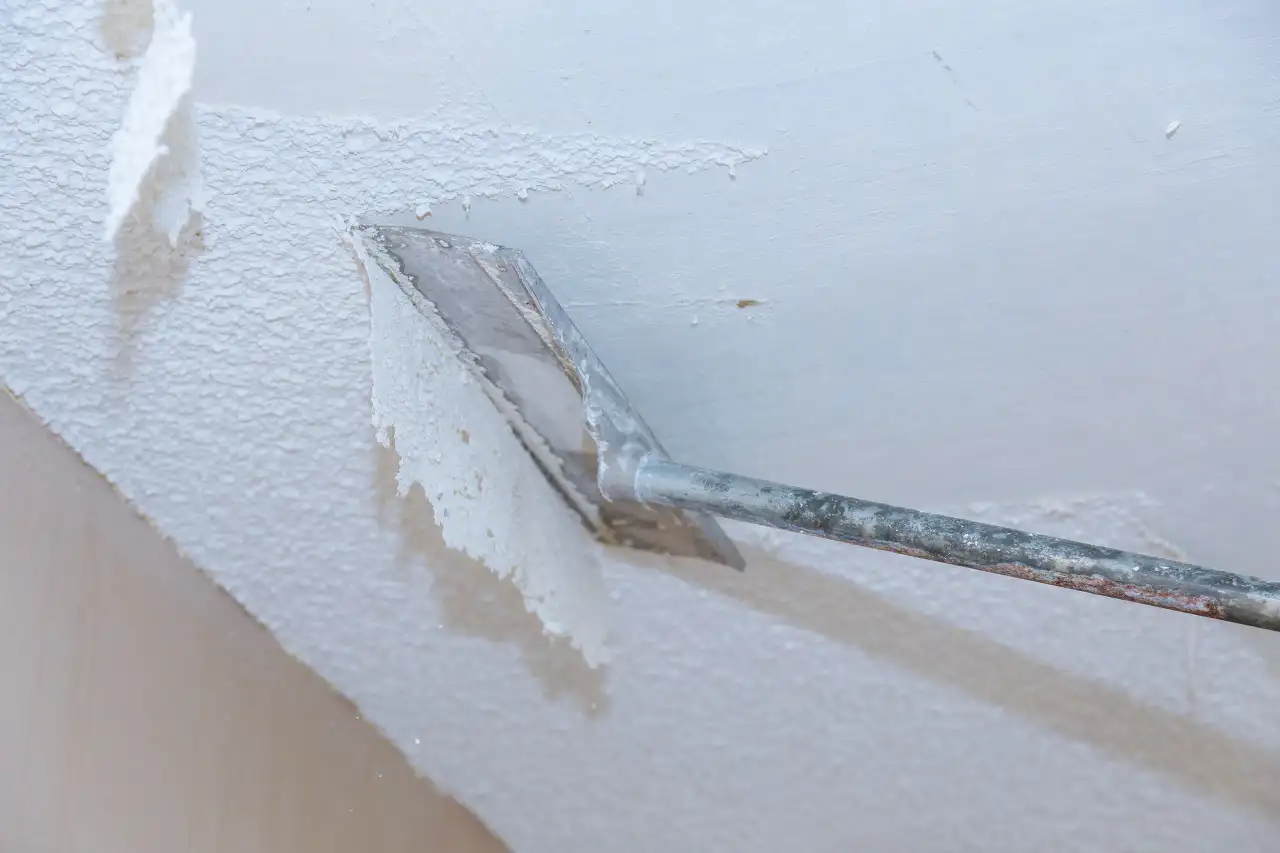
For unpainted texture that tests clear, removal is a wet process. We mist the ceiling so the texture softens and scrapes off with far less airborne dust, after protecting the floors, walls, and fixtures and containing the room. Painted popcorn is a different animal, because the paint seals the texture so it will not absorb water and will not wet-scrape, so rather than fight it we skim-coat over it to a smooth finish, which gets you the same result without the mess of dry-scraping. Once the texture is gone, the ceiling almost always reveals what it was hiding: cracks, old water stains, prior patches. We repair those, seal any stains with a stain-blocking primer so they do not bleed through, then skim, sand, and finish the ceiling smooth to a GA-214 Level 4 finish, or Level 5 where strong light would show every imperfection, and prime it paint-ready. If you would rather have a light modern texture than dead-flat, we can apply that instead.
Why it’s worth doing right
A smooth ceiling reflects more light, photographs better, and instantly modernizes a room, which is why it is such a strong move before a sale and such a satisfying one if you are staying. The difference between a good popcorn removal and a regrettable one is almost entirely in the parts you cannot see in the after photo: whether it was tested, whether the mess was contained, and whether what the texture was hiding got fixed before the finish went on. That is the standard we work to across Hartford’s post-war suburbs and older neighborhoods.
Materials & standards
Products & materials we use
- USG and National Gypsum Gold Bond joint and topping compounds for skim and finish
- Setting-type compound (Durabond, Easy Sand) for repairs
- Stain-blocking primer for sealing old water stains before the finish
Standards & codes we work to
- EPA and CT DEEP asbestos regulations; federal NESHAP asbestos rules
- CT-licensed asbestos abatement contractor requirement for a pre-1980 positive result
- GA-214 Level 4 and Level 5 finish standard
- EPA RRP lead-safe rule where lead paint is also present in a pre-1978 home
- 2022 Connecticut State Building Code where a permit is triggered
What the terms mean
- Acoustic or "popcorn" texture; wet-scrape
- ACM (asbestos-containing material) testing
- Encapsulation and cover-over
- Skim coat; smooth Level 4 and Level 5 finish
- Stain-blocking and sealing before finish
Options & variants
| Option | When it applies | Cost |
|---|---|---|
| Scrape + skim to smooth (asbestos-negative) | Tested clear, or post-1980; standard removal and smooth refinish | Baseline pricing |
| Test-first then proceed | Pre-1980 home or unknown age; testing precedes any scraping | Adds testing cost and a short scheduling gap |
| Abatement-then-refinish (asbestos-positive) | Licensed abatement contractor removes the texture; we refinish after clearance | Higher — abatement is a separate cost; our scope is the finish |
| Cover / encapsulate (drywall over) | Where scraping is not viable; new board hung over the existing ceiling | Alternative scope; sometimes chosen for asbestos-positive ceilings |
| New texture instead of smooth | Customer prefers a light knockdown or orange peel over dead-flat | Adds texture application |
| Ceiling repair included | Cracks or stains revealed once the texture is off | Adds repair scope |
What affects cost
- • Asbestos status — testing, and a licensed abatement step if positive, changes the whole project on a pre-1980 ceiling
- • Square footage — total ceiling area is the primary driver
- • Ceiling height and access — vaulted or high ceilings add staging and labor
- • Condition underneath — cracks, old stains, and bad prior patches revealed after scraping add repair time
- • Smooth versus new texture — a smooth Level 4 or Level 5 finish differs from applying a fresh texture
- • Occupied versus empty — furnished rooms need protection and containment; empty pre-sale homes move faster
- • Painted-over popcorn — texture that has been painted resists wet-scraping and often needs a skim-coat approach instead
- • Number of rooms — whole-house jobs gain some efficiency per room
Price ranges
Low end
$850–$1,200
A room or two, tested clear or post-1980, standard height, scrape plus smooth finish
Typical
$1,200–$1,900
Several rooms or the main living areas, smooth Level 4 or 5 finish, minor repairs, primed
High end
$1,900–$2,600+
Whole house, vaulted or high ceilings, repairs under the texture, new texture, or a painted-popcorn skim approach
What to expect
- 1
Assessment and age check
We look at the ceiling, the age of the home, and whether the texture has been painted. For pre-1980 homes, and any home whose age is uncertain, we recommend asbestos testing before anything is scraped.
- 2
Asbestos testing (pre-1980 / unknown)
A sample is tested. If it is negative, we proceed with standard removal. If it is positive, removal is handled by a licensed asbestos abatement contractor first; we do not scrape asbestos-containing material.
- 3
Containment and protection
Floors, walls, and fixtures are protected and the room is contained. Scraping is messy, so this matters most in an occupied home.
- 4
Removal
Unpainted texture is typically misted and wet-scraped to hold the dust down. Painted popcorn that will not wet-scrape is skim-coated over instead, because wet-scraping fails on a sealed texture.
- 5
Repair underneath
Cracks, old stains, and prior patches that the texture was hiding are repaired before finishing.
- 6
Skim and finish
The ceiling is skim-coated, sanded, and finished smooth to a GA-214 Level 4 finish, or Level 5 where strong light would show every imperfection, or a new chosen texture is applied.
- 7
Prime and handoff
The ceiling is primed paint-ready. For pre-sale homes we leave it photo-ready; for occupied homes we clean up thoroughly.
When this isn’t the right call
- If the home is pre-1980 and the ceiling is untested → Do not scrape first. Testing comes before removal, always.
- If the texture tests positive for asbestos → A licensed abatement contractor must remove it; we refinish after clearance, or cover and encapsulate as an alternative.
- If the ceiling has active water damage → Fix the leak and address the water or mold first. Better fit is Water Damage Drywall Repair.
- If you actually want a textured look → If you like texture and just want it refreshed, that is a texture scope, not removal. Better fit is Texture Matching.
- If the ceiling is failing plaster, not drywall popcorn → That is a plaster repair or conversion. Better fit is Plaster Repair & Conversion.
Frequently asked questions
Does my popcorn ceiling have asbestos? +
Possibly, if the home was built or textured before 1980, because acoustic ceiling texture from that era can contain asbestos. The only way to know is a test, which is exactly why we test before scraping anything in older Hartford-area homes rather than guessing. Handled this way it is a routine safety step, not a deal-breaker.
What happens if it tests positive? +
Then the texture is removed by a licensed asbestos abatement contractor first, which is a regulated specialty we do not perform, and we refinish the ceiling smooth after clearance. In some cases covering the ceiling with new drywall (encapsulation) is a practical alternative. We walk you through the options.
How much does popcorn ceiling removal cost in the Hartford area? +
For a typical project of several rooms with standard ceilings, scraped and finished smooth, most jobs land in the low four figures. A room or two costs less; a whole house, high ceilings, repairs under the texture, or asbestos abatement push it higher. We give a firm number after seeing the ceilings and confirming the home's age.
It's really messy, and I live here. How do you handle that? +
Removal is messy, which is why containment and protection are half the job. We protect floors, walls, and fixtures, contain the room, and wet-scrape unpainted texture to keep dust down. You can usually stay in the home while we work room by room.
My popcorn has been painted. Does that change anything? +
Yes. Painted popcorn resists wet-scraping because the paint seals the texture, so instead of fighting it we typically skim-coat over it to a smooth finish. It is a different approach but gets you the same smooth ceiling.
Can you fix the cracks and stains I know are hiding up there? +
Yes. Once the texture is off we repair whatever it was hiding, cracks, old stains, prior patches, and seal any stains before we finish, so you get a genuinely smooth, clean ceiling rather than a smooth ceiling with the old problems showing through.
Smooth or a new texture? +
Your call. Most people want smooth, modern ceilings, but if you prefer a light knockdown or orange peel we can apply that instead. Smooth reflects the most light and reads the most current.