
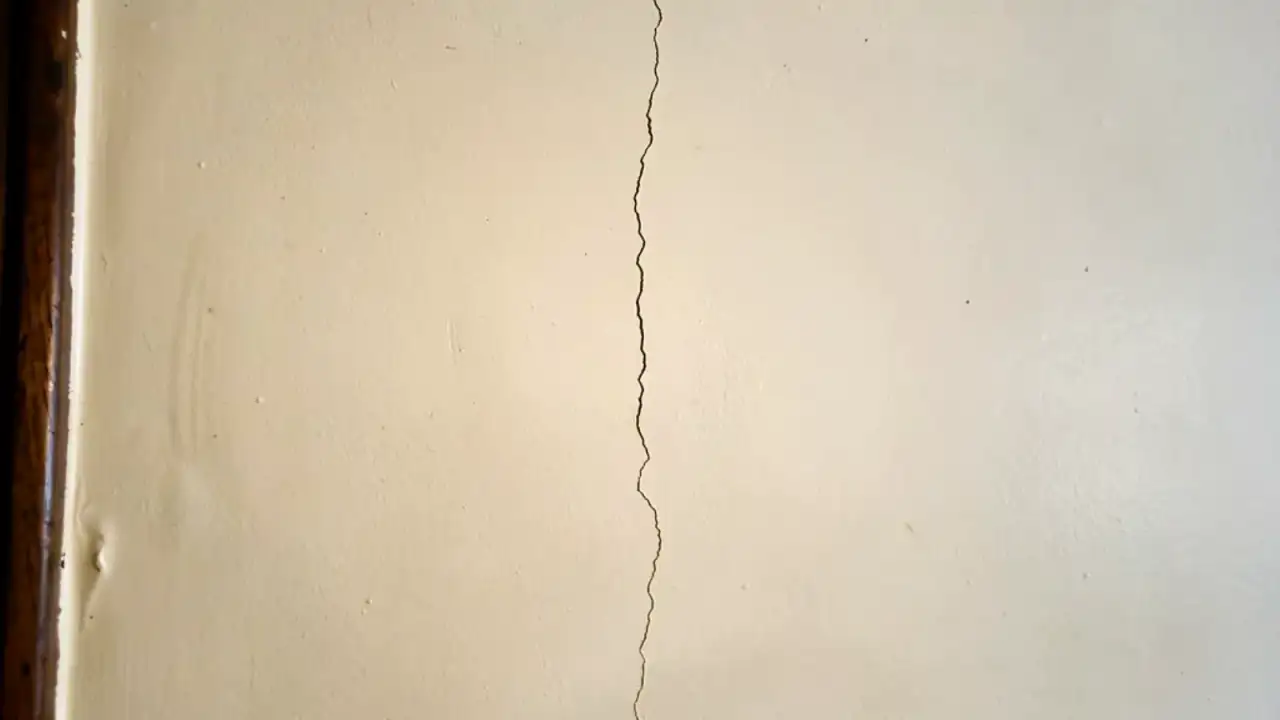
Signs you need this
- • Cracks radiating from the corners of doors and windows (stress points)
- • A long straight crack along a ceiling or wall seam where the tape has failed
- • The same crack coming back in the same spot after every repaint
- • Hairline cracks that open a little wider in winter and close up again in summer
- • A crack along the joint where the wall meets the ceiling
- • A crack tracking down an outside corner where the metal corner bead has separated
Drywall Crack Repair in Hartford
The most frustrating thing about a drywall crack is not the crack, it is that it comes back. You fill it, you paint it, it looks perfect, and a season later the same thin line reappears in exactly the same place. That is not bad luck and it is not bad filler. It is the difference between covering a crack and repairing one. A crack is information about what the wall is doing, and a repair that ignores that information is just a countdown to the next one. Across Hartford’s housing, from the pre-1940 plaster-and-drywall homes in Frog Hollow and the West End to newer builds settling out in Glastonbury and South Windsor, most cracks are cosmetic and fixable for good, as long as you address why they are there.
Why cracks happen, and why fills fail
Houses move, and in Hartford they move a lot. Wood framing takes on moisture through a humid Connecticut River summer and gives it back through a dry, freezing heating season, foundations settle slightly over years, and all of that movement concentrates at the weak points: the corners of doors and windows, the seams between sheets of drywall, the joint where wall meets ceiling, and the outside corners where the corner bead lives. A crack appears where the stress is highest. When you fill it with a dab of lightweight compound, you have bridged a still-moving joint with something rigid and brittle, so it splits again at the first freeze-thaw swing. The durable fix is to cut the failed area out, re-tape the joint properly with embedded tape, and use setting-type or movement-tolerant materials at the spots that flex, so the repair moves with the wall instead of fighting it. A separated corner bead gets removed and re-set rather than skimmed over, because a bead that has pulled away from the corner will keep cracking the mud on top of it no matter how many coats go on.
Cosmetic or structural: the honest distinction
The single most useful thing a real tradesperson does with a crack is tell you which kind it is. The overwhelming majority of drywall cracks in Hartford are cosmetic, tied to seasonal movement, minor settling, or failed tape, and they are a straightforward drywall repair. But a few patterns deserve a second look before anyone just covers them: stair-step cracking, cracks that keep getting visibly wider, or cracks that show up alongside doors and windows that have started sticking and floors that feel off. Those can point to structural movement that a drywall patch would only hide. We will flag that honestly and tell you to get a structural look first, rather than take your money to mask a symptom.
The old-home question: drywall crack or plaster crack
A lot of Hartford’s oldest neighborhoods, Frog Hollow, the West End, Asylum Hill, Parkville, and Barry Square, are full of pre-war homes built with plaster on wood lath, often with drywall added later in remodeled rooms. That matters for cracks, because a recurring crack in original plaster is usually a plaster-specific problem, the plaster keys that grip the lath letting go, and it needs a plaster repair, not a drywall patch. We look at the wall before we quote it so the right repair goes on the right surface. If it is drywall, we handle it here. If it is plaster keying off the lath, that is our plaster repair and conversion work. Getting that call right up front is the difference between a repair that lasts and one that fails again in a year.
Making it disappear and stay gone
Once the joint is properly re-taped and reinforced, the rest is finish work: thin coats feathered into the surrounding wall, the texture matched so the repair does not read as a smooth stripe, and a primer coat so it will not flash under paint. We cannot promise a hundred-year-old home in the West End will never move again, but we can make the repair resilient to the movement that is actually there, so you stop repainting the same line every year. When a crack runs along a ceiling seam, it pairs naturally with ceiling repair; when there are holes as well as cracks, it pairs with patching; and where texture has to be blended back in, it pairs with texture matching.
Materials & standards
Products & materials we use
- Setting-type compound (Durabond / Easy Sand) for durable joints
- Paper tape and mesh tape, plus flexible movement-tolerant patching products
- Corner bead (metal, vinyl, or paper-faced)
- USG Sheetrock joint compound
Standards & codes we work to
- GA-214 finish levels (Level 4 finish)
- ASTM C840 (application of gypsum board)
- 2022 CT State Building Code
- CT DCP Home Improvement Contractor (HIC) registration
What the terms mean
- Stress crack, settling crack, seasonal movement, freeze-thaw movement
- Failed seam and tape failure, re-taping
- Corner bead separation
- Setting versus topping compound, feathering
- Plaster on lath, plaster keys (old-home cracks, separate repair)
- Structural versus cosmetic crack
Options & variants
| Option | When it applies | Cost |
|---|---|---|
| Single hairline/stress crack | One crack at a door/window corner or a seam | Lower |
| Failed-seam re-tape | Tape has cracked or lifted along a joint | Low–mid |
| Corner-bead crack repair | Cracking down an outside corner where the bead has separated | Mid |
| Recurring-crack proper fix | A crack that keeps returning and needs the cause addressed | Mid |
| Multiple cracks (whole-home) | Seasonal and settling cracks throughout an older home | Bundle |
| Movement-joint detailing | Long runs and transitions that need a flexible treatment | Mid |
What affects cost
- • Number and length of cracks — one corner crack vs. cracks throughout a whole house
- • Cause and recurrence — a quick fill vs. cutting out and re-taping to actually stop the return
- • Corner bead involvement — a separated or cracked bead has to be removed and replaced, not just filled
- • Ceiling vs. wall — overhead work is slower and harder to blend
- • Texture — matching texture over the repair adds labor
- • Access and height — stairwell cracks and high ceiling lines
- • Underlying issue — if the crack pattern points to structure, that's a separate (non-drywall) assessment
- • Substrate — whether it's drywall or original plaster on lath changes the repair entirely
Price ranges
Low end
$250–$400
A single crack cut out, re-taped, finished, texture-matched, and primed
Typical
$400–$600
Several cracks or a corner-bead repair, properly addressed and finished
High end
$600–$800+
Whole-home seasonal cracks, multiple corners, ceiling seams, and texture work
What to expect
- 1
Diagnose the crack
We look at where the crack runs and how it behaves to judge the cause: a stress crack at a door corner, a failed tape seam, a separated corner bead, or seasonal movement in an older home. We flag the rare case where the crack pattern suggests a structural issue rather than normal movement.
- 2
Address the cause
For a failed seam, we cut out the cracked tape and re-tape the joint properly. For a corner bead, we remove and replace the separated section. For movement-prone joints, we use setting-type or flexible materials that tolerate the seasonal swing Hartford's climate puts on a house.
- 3
Reinforce
Proper tape, paper or mesh as the joint calls for, embedded correctly so the joint resists re-cracking, instead of a thin smear of filler that will split again at the first freeze-thaw.
- 4
Finish
Multiple thin coats, feathered out and sanded smooth so the repair has no ridge.
- 5
Texture match
Matched to the surrounding surface wherever the wall or ceiling is textured, so the repair does not read as a smooth stripe.
- 6
Prime and hand off
Primed and paint-ready so the repair does not flash under paint and the crack stays gone.
When this isn’t the right call
- If the cracks point to a structural problem → Stair-step cracking, doors that won't close, or cracks that keep widening with floor movement need a structural assessment first; drywall repair alone would only mask it.
- If it's plaster cracking in an old home → Plaster keys letting go from the lath in a pre-war home has its own approach. See: Plaster Repair & Conversion.
- If it's a hole rather than a crack → See: Drywall Repair & Patching.
- If a whole wall needs to be flawless under raking light → See: Skim Coat & Level 5 Finish.
- If the crack comes from a water leak → Resolve the leak first and assess the damage. See: Water Damage Drywall Repair.
Frequently asked questions
Why does my crack keep coming back every time I paint? +
Because filling a crack does not address why it is cracking. Most recurring cracks sit at movement points, the corners of doors and windows or a ceiling seam, or over a joint where the tape underneath has failed. We cut out and re-tape the joint properly, or use materials that tolerate seasonal movement, so the repair handles the movement instead of splitting over it again. In Hartford that movement is real: a house goes through a humid summer and a dry, freezing winter every year, and a rigid dab of filler cannot ride that.
Are cracks in my walls a sign of foundation problems? +
Usually not. The large majority of drywall cracks are cosmetic, tied to normal seasonal expansion and contraction, minor settling, or failed tape. A few patterns do warrant a closer look: stair-step cracks, cracks that keep widening, or doors and windows that have started sticking. We will tell you honestly if what we see suggests a structural assessment before we just cover it.
What causes the cracks at the corners of my doors and windows? +
Those are stress points. The framing around an opening concentrates the small movements a house makes with the seasons and with settling, and the drywall cracks at the corner where that stress is highest. They are common and cosmetic, and the fix is re-taping the joint properly so it resists re-cracking rather than filling the line.
My house was built recently in Glastonbury and it is already cracking. Is that normal? +
Yes. A new house settles most in its first couple of years as framing dries out and the structure finds its load. First-year and second-year settling cracks at door corners and seams are common in newer suburban builds and are cosmetic. We repair them properly once, and by then most of the initial settling has already happened.
Can you fix the crack so it actually stays fixed? +
That is the goal, and it is why we treat the cause rather than just filling. A properly cut-out, re-taped, and reinforced joint stays put far better than a smear of filler. We cannot promise a hundred-year-old house in the West End will never move again, but we make the repair resilient to the movement that is actually there.
Will the repair be invisible? +
Yes, once it is finished, texture-matched, and primed. We feather the repair into the surrounding wall, match any texture, and prime it so it does not flash under paint.
I have cracks all over an older Hartford home. Is that a problem? +
In an older Hartford home some seasonal cracking is normal, and we can address it in a bundle. If it is an old plaster-on-lath house in Frog Hollow, Asylum Hill, or Parkville, the cracks may be plaster-specific, the plaster keys letting go from the lath, which is a different repair covered on our plaster page.