
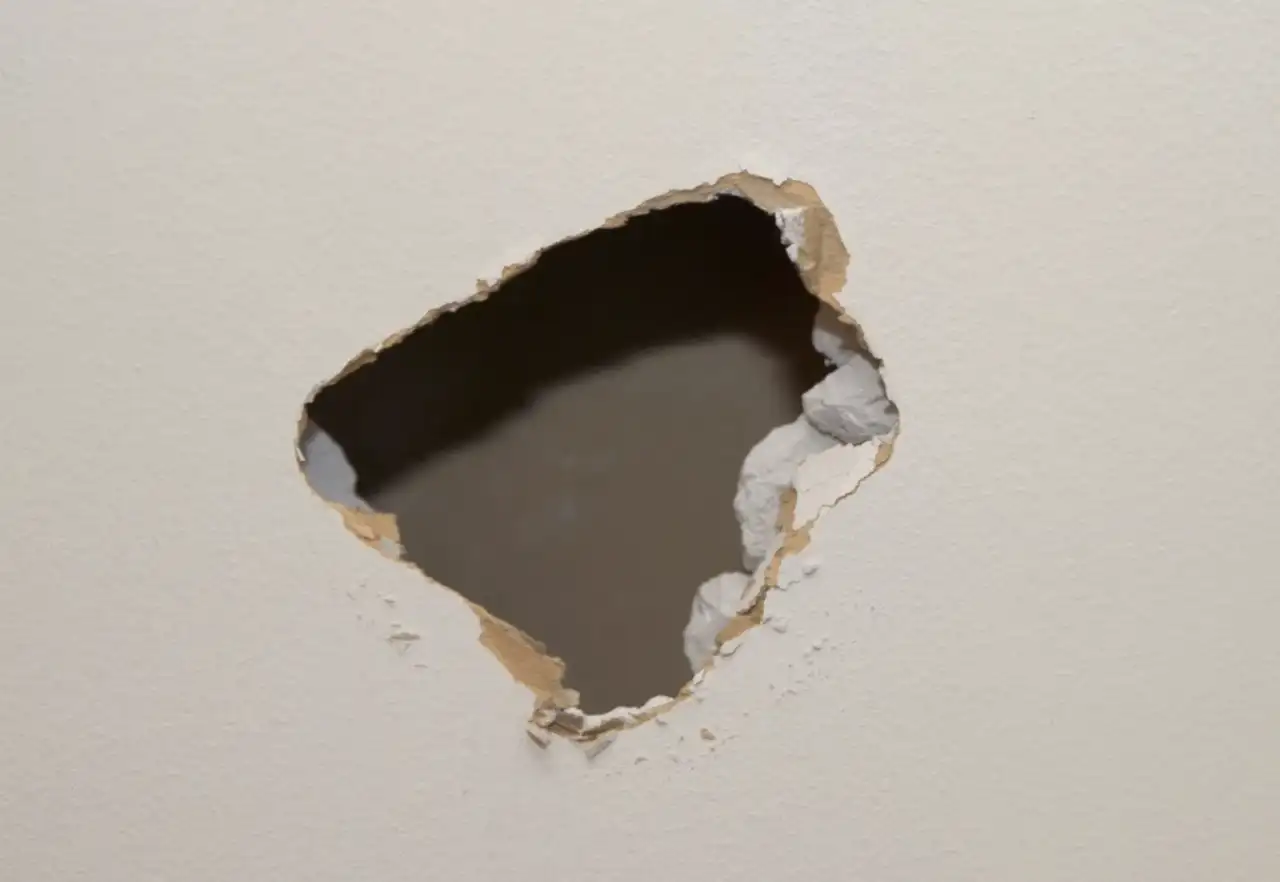
Signs you need this
- • Holes from doorknobs, furniture, or moving mishaps
- • Anchor holes and torn paper left after removing a mounted TV, shelves, or fixtures
- • Nail pops and screw pops bulging through the paint
- • Dented, scuffed, or crushed outside corners
- • Small cracks at the corners of doors and windows
- • A previous patch (often a prior owner's) that shows through the paint
Drywall Repair and Patching in Hartford
Drywall damage is the most ordinary home problem there is: a doorknob punched through the wall, a row of anchor holes where a shelf used to hang, the nail pops that bulge through the paint every few years, the corner the moving truck found on the way in. None of it is dramatic, and all of it is annoying, because it is the stuff that makes an otherwise nice room in West Hartford or Glastonbury look neglected. It is also the stuff people most often try to fix themselves and most often regret, because a bad patch, the lumpy spot that flashes through every future coat of paint, ends up more obvious than the hole it replaced. The whole value of hiring this out is a repair you genuinely cannot find afterward.
What makes a patch invisible
There are really only two reasons a patch shows after painting, and both are avoidable. The first is texture. Hartford-area walls and ceilings are a mix of smooth and textured surfaces, and a smooth patch dropped into a textured wall reads as an island no matter how flat it is, so we sample and match the surrounding texture, knockdown or orange peel or whatever is there, as part of the repair. The second is priming. Bare joint compound absorbs paint differently than the painted wall around it, so an unprimed patch flashes, showing as a duller or shinier spot, under the first coat. We prime every repair paint-ready. Add proper feathering, where the compound is built in thin coats that fade into the surrounding wall instead of sitting proud of it, and the patch disappears.
The right method for the damage, and pops that stay fixed
A pinhole, a doorknob hole, and a foot-wide hole are three different repairs. Small damage gets filled and taped; medium holes get a backed or cut-in patch so there is solid board behind the compound; large holes get a proper board section let into the wall. Crushed outside corners get the bent corner bead cut out and replaced, not just mudded over. And nail pops, the most common callback in the trade, only stay fixed if you address the fastener that is moving, which means re-securing the area rather than smearing compound over a screw that is going to push back out. That matters more here than in a warmer climate: Hartford’s winter freeze-thaw cycle makes framing move seasonally, and a pop that is only filled will be back by spring. Matching the repair to the damage is what separates a lasting fix from one you will be looking at again in a year.
Drywall, not plaster: knowing which wall you have
One thing worth checking before you call this the right job. A lot of Hartford’s older housing, the pre-war stock in Frog Hollow, the West End, Asylum Hill, Parkville, and Barry Square, is plaster on wood lath, not drywall. Plaster repairs differently: it fails when the plaster keys break off the lath behind it, it crumbles into chalky chunks rather than crushing like gypsum board, and a crack in it tends to come back if it is only filled. If that describes your walls, the fix belongs on our plaster repair and conversion page, not here. Most post-war homes and the suburban ring are standard drywall, which is what this service covers, and we will tell you which you have before any work starts.
Small jobs, done right, add up
Individually these are small jobs, and most people bundle several into one visit, which is the sensible way to clear a backlog of accumulated damage before a repaint, a move, or a sale. For landlords cycling units across the metro and sellers prepping a house for the market, the same craft scales into the turnover and pre-sale work covered on those pages. Whatever the scale, the standard is the same: the right patch method, the texture matched, the surface primed, and a wall that looks like nothing ever happened to it.
Materials & standards
Products & materials we use
- USG Sheetrock / National Gypsum Gold Bond joint and setting compounds
- Self-adhesive mesh tape, paper tape, patch kits, corner bead
- Stain-blocking primer
Standards & codes we work to
- GA-214 finish levels (Level 4 for most repairs)
- ASTM C840 (application), ASTM C1396 (board)
- CT DCP Home Improvement Contractor (HIC) registration
What the terms mean
- Backed patch / California (butterfly) patch
- Nail pop / screw pop; re-securing
- Corner bead; outside corner
- Feathering; setting versus topping compound
- Texture match (knockdown, orange peel)
- Plaster on lath (the pre-war alternative to drywall)
Options & variants
| Option | When it applies | Cost |
|---|---|---|
| Small patch (nail pops, anchor holes, dings) | Minor, localized damage | Lowest |
| Medium hole patch | Doorknob or furniture holes up to a few inches | Low–mid |
| Large hole / section patch | Bigger holes needing a backed or California patch | Mid |
| Corner / corner-bead repair | Crushed or dented outside corners | Mid |
| Multi-spot repair visit | Several areas cleared in one trip | Efficient bundle |
| Texture-matched repair | Walls or ceilings with existing texture | Adds a texture step (see texture matching) |
What affects cost
- • Size and number of repairs — one nail pop versus a wall of accumulated damage
- • Hole size — small fills versus backed or cut-in patches that need fresh board
- • Texture — matching an existing knockdown or orange-peel texture adds labor over a smooth wall
- • Ceiling versus wall — overhead work is slower and messier
- • Access — high walls, stairwells, and furnished rooms slow the job
- • Paint readiness — whether priming is included (paint itself is a separate trade unless coordinated)
- • Travel and minimum — a single tiny repair may carry a service minimum to make the trip worthwhile
Price ranges
Low end
$150–$275
A few small patches or nail pops in one visit, smooth wall, primed
Typical
$275–$450
Several repairs or a medium hole with a texture match, primed paint-ready
High end
$450–$600+
Large or multiple holes, corner-bead work, texture matching, ceiling repairs
What to expect
- 1
Quick assessment
We look at the damage, often from photos for scheduling, and confirm the repairs and whether a texture match is needed.
- 2
Prep
The area is protected; loose material, failed prior patches, and popped fasteners are removed or reset.
- 3
Patch
The right method for the size: fill and tape for small damage; a backed or cut-in board patch for larger holes; corner bead replaced where a corner is crushed. Nail and screw pops are re-secured properly so they do not return.
- 4
Tape and finish
Seams are taped and feathered with multiple thin coats, then sanded smooth so the patch blends into the surrounding wall.
- 5
Texture match
Existing texture is sampled and matched so the repair does not read as a smooth island.
- 6
Prime and handoff
The repair is primed paint-ready (priming is what keeps a patch from flashing under paint). We clean up and leave it ready for your painter or ours.
When this isn’t the right call
- If it is a recurring crack, not a one-time patch → the movement needs addressing, not just filling. Better fit is Drywall Crack Repair.
- If the damage is water- or mold-related → that needs proper assessment first. Better fit is Water Damage Drywall Repair or Mold Drywall Replacement.
- If it is old plaster-on-lath failing (common in pre-war Hartford homes) → that is a plaster scope, not a drywall patch. Better fit is Plaster Repair & Conversion.
- If you want a whole wall flawless under critical light → that is a skim or Level 5 scope. Better fit is Skim Coat & Level 5 Finish.
- If it is many units of rental turnover → use the landlord-optimized scope. Better fit is the landlord turnover page.
Frequently asked questions
Will the patch show after I paint? +
Not if it is done right. The two things that make patches show are skipping the texture match and skipping primer. We feather the patch with multiple thin coats, match the surrounding texture, and prime it paint-ready, so it blends in instead of flashing through the first coat. A lumpy, visible patch is exactly what you are paying to avoid.
Do you fix nail pops so they stay fixed? +
Yes. Nail and screw pops come back if you just fill over them, because the fastener underneath is still moving, and Hartford's winter freeze-thaw swings make that worse. We re-secure the area properly, usually adding a screw and driving or removing the popped fastener, before finishing, so it does not pop again next season.
How small a job will you do? +
We do small repairs, though a very small single job carries a service minimum to make the trip worthwhile. Most people bundle several repairs into one visit, which is the most cost-effective way to clear accumulated damage across a house.
Can you match my textured walls or ceiling? +
Yes. Knockdown, orange peel, or other textures are sampled and matched so the repair disappears. Texture matching is its own small skill; a patch left smooth on a textured wall is obvious. See our texture matching page for how that works.
My house is old and the walls feel hard — is that drywall or plaster? +
Many pre-war Hartford homes in Frog Hollow, the West End, Asylum Hill, and Parkville have plaster on wood lath rather than drywall, and it repairs differently. If a spot crumbles into chalky chunks or the crack keeps coming back, that is likely plaster, and it belongs on our plaster repair page. We will tell you which you have before we start.
Do you paint too? +
We finish primed and paint-ready and can coordinate painting. The drywall finish is what makes the paint look good, so we get the surface right first; many customers have their own painter take it from there.
How long does it take? +
Most repair visits run from a few hours to a day, but multiple coats need dry time between them, so a job with larger patches may span two short visits. We tell you the schedule up front.